In my early 20s, my first boss told me to “write down my values.” At the time, I thought it was folksy advice. 🙃 It lacked context or how-to, but he was wise, so I complied. Later that evening, I scribbled a handful of words in a journal–respect, fairness, creativity, collaboration, and excellence. Yeah, that defines me. This is what is important to me at this stage of my life.
Several years later, when my boss had moved on and I had no one guiding me at the company, I phoned him in distress about a particular workplace dynamic. He said, “Revisit your values, and you’ll know what to do.”
Hmmm. 🤔
So, I uncovered that journal from a box in my basement and pondered those five words again.
My current work situation was violating nearly each of my values. I felt disrespected by the lack of fairness in compensation. I was being paid 50% less than a male colleague with the same role, title, and years of experience. My skills were stagnating as the best projects were assigned to new talent from an acquisition. I felt that our previous team-based approach was being overtaken by a new, demanding creative leader, which hindered my ability (or motivation) to perform at the highest level.
Using my values to guide my decision, the choice was obvious: time to go. So I did.
In my latest book, UP!: The Playbook for Every Woman on the Rise, I explain the importance of values and how to arrive at yours. Here’s an excerpt:
Your personal values are an expression of what’s most important to you in your work and life. They are ideals that are true to you and you appreciate seeing in others. They often determine how you spend your time, how you behave, and how you respond to what’s happening around you. They influence every practical aspect of your life, from where you live and work to who your friends are to what you do with your money. As much weight as they hold, though, most people aren’t fully conscious of their values. Unless specifically asked to consider how they would describe their values, they likely don’t give them much thought. Which is a shame, given what a tremendous asset your values can be in building the future you hope for.
In fact, your values are the foundation of self-leadership. On a good day, they help keep you grounded, grateful, and focused. On a day when you’re struggling, they remind you of who you are and what you care about and help get you back on track. On any kind of day, your values help move you toward your goals—but first you have to know what they are!
Start by reviewing this list of possible values. Scan it for a few minutes and select five to ten words that resonate with you. Resist thinking about what other people would expect you to choose. All that matters is that your values speak to what’s important to you. If the words on this list don’t capture your values, choose your own.
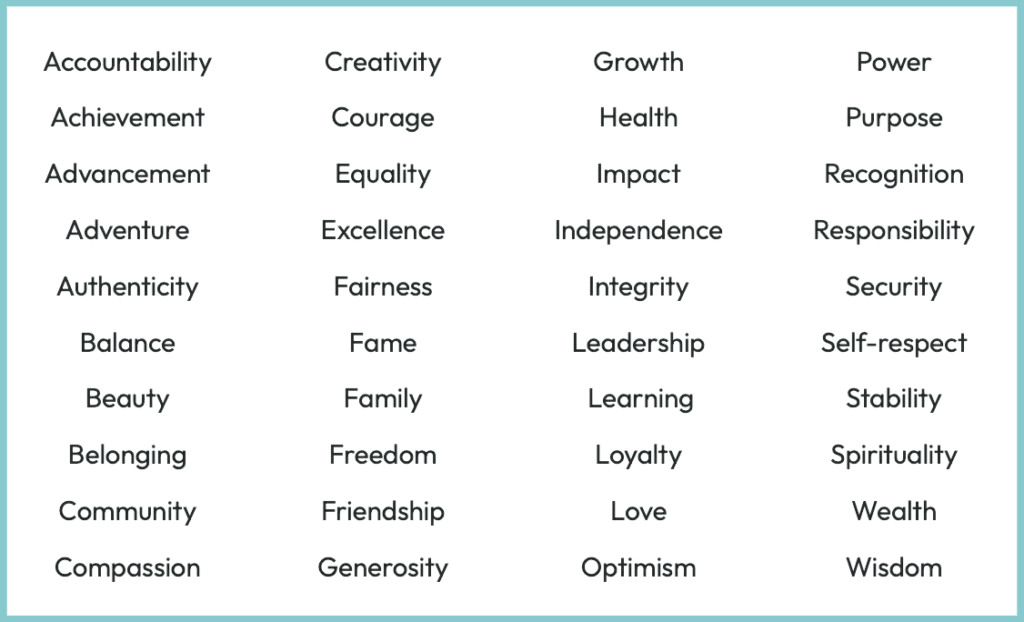
Define each word for yourself. Words mean different things to different people, so define what they mean to you. If “health” is a value for you, it could mean that you place a high priority on physical fitness, such as working out and eating well. Or that same value could mean holistic health that incorporates the physical, mental, emotional, social, and spiritual aspects of your well-being.
Look again at your values and definitions. Do they ring equally true to you or are some values much more important to you than others? Do any of them overlap? If so, you might consolidate words and refine your definition to reflect the value’s essential meaning to you. For example, if “generosity” and “community” are values you’ve identified, could “impact” be a term that accurately encompasses both? Try to narrow your list to the five values that are most important to you. (Why five? Because you want to keep your values front of mind and most people find it difficult to remember more than five things at once.)
Identify key behaviors associated with each value. These behaviors should relate to how you live each value or how you aspire to live them. For example, the behaviors described below might relate to someone’s “health” value. If health is one of your values, your list of behaviors could be very different. Only you can say which behaviors make a value real for you.
- Following physical and mental health news
- Scheduling routine wellness appointments
- Exercising regularly
- Following a particular diet
- Sleeping eight hours each night
- Limiting alcohol consumption
- Disconnecting from work email and texts when at home
- Socializing with friends and family
- Managing workload and boundaries
This exercise will take some time. Don’t rush it or give up. Let the five values you land on simmer in the back of your mind for a week or two. Then return to it and refine or finalize your list of values, definitions, and behaviors. Keep it handy so you can refer to it as you contemplate new challenges or circumstances. And refresh your list as your sense of self and priorities evolve over time. What mattered most to you as a college grad may be different from what matters to you at a later stage of your life.
Use your values. Now that you have a vocabulary for your values, use your values to guide your actions and advocate for your wants and needs. For example, if you value flexibility but have been experiencing burnout, you could have a conversation with your manager that goes something like this:
“I’d like to talk about the number of days I spend in the office and the possibility of reducing it from three to two days. Being on-site on Tuesdays and Thursdays when my key meetings occur would allow me to make the most of my in-person time in the office and continue contributing at a high level. Could we try this for three months and see how it’s working for the company, our team, and me?”
In the book, I share the story of Allie, a salesperson who was burning out and learned how to use her values to find a more fulfilling role with her existing employer. Get the rest of her story and other freebies when you pre-order the book. You’ll be one of the first to receive it when it releases on June 2, 2026.
You’re equipt to define and use your values for a happier career and life.