What is work-life balance anyway?
- Leaving at 5:00pm?
- Working reasonable hours?
- Having a career and a family, without burning out?
- Having autonomy over when, where, or how you work?
And why is the Internet all up in a huff about Oprah’s recent remarks about work-life balance on Keke Palmer’s pod? In short, she said, “…you’re not supposed to have work-life balance at 22.” Then followed up by saying that one needs to “lay in the work” before earning the right to freedom and flexibility.
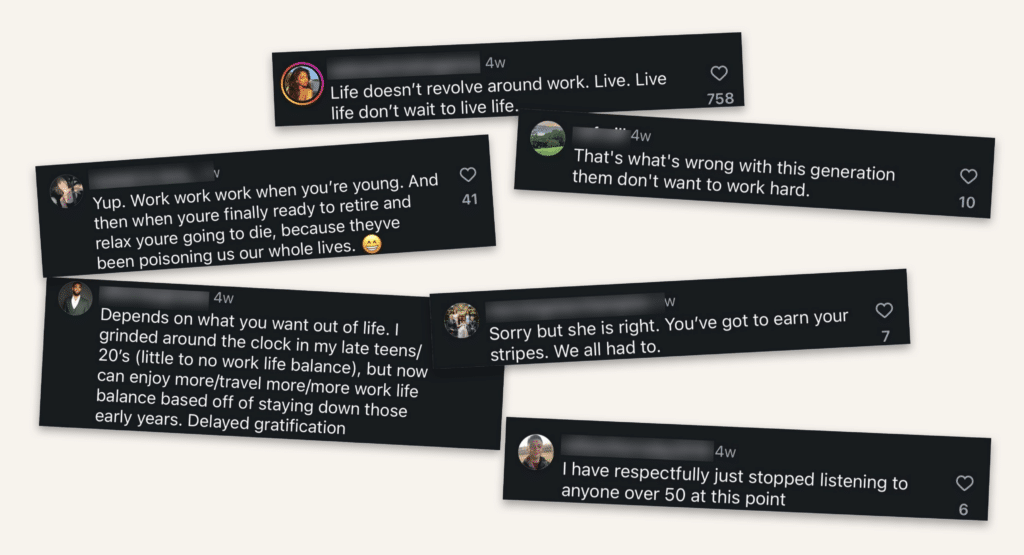
It’s almost entertaining to read the comments. The generations reveal themselves.
- Boomers (born 1946-1964) – I put in the work; you should too.
Boomers built careers on the idea that work comes first. Loyalty, long hours, and delayed gratification were the deal. If you gave your job everything, you would be taken care of. “Balance” wasn’t even in the collective vocabulary. Back then, as most Boomers were building careers, it would have been unthinkable to move in with parents, so they kept their heads down, working late nights, weekends, and often holidays. - Gen X (born 1965-1980) – I just stopped expecting anything from my employer.
Gen X grew up watching their Boomer parents or relatives remain loyal to companies that still laid them off during economic downturns. That experience bred real cynicism about the workplace. Gen X tends to be less trusting of employers, more self-reliant, and more likely to quietly protect their personal time rather than make noise about it. When building their careers, they just left work at a reasonable hour, didn’t talk about it, and hoped nobody noticed. - Millennials (born 1981-1996) – I work hard, but don’t trust there will be a payoff.
Millennials were rocked by the 2008 recession. They experienced the fallout firsthand. It was hard to get a job, and when they did, they discovered burnout. They resented hustle culture yet, ironically, started side gigs that contributed to overworking, because their identity was still tied to their career and perhaps, it was a form of self-expression and a way to make ends meet. Millennials stopped trusting that grinding is ultimately worth it, so they began negotiating for flexible hours and remote work. - Gen Zers (1997-2012) – I’m not signing up for that deal.
Gen Zers are quite different, and the other generations are unsure whether to thank them or to spite them. (I thank them.) Gen Z doesn’t buy into the “earn it later” notion. In fact, they’re expecting–and in some cases, demanding–work-life balance from day one. They’re asserting boundaries, asking for flexibility and mental health accommodations as part of the job, not a perk in ten or fifteen years. Gen Z doesn’t view this as entitlement. Instead, they refuse to repeat mistakes they watched their parents make, coupled with feeling overwhelmed by the forces out of their control: climate change, AI eliminating jobs, income inequality, and more.
Every generation developed a different relationship with work based on what they experienced. Now, all four generations are in the workplace together, often judging each other for those differences.
It’s also worth recognizing just how much the workplace itself has changed. Amanda Schneider, author of “Work for What’s Next”, says that for Boomers and Xers, work is a noun – a place. And for Millennials and Gen Zers, she says work is an adjective – something you do when you open your laptop, from virtually anywhere. That’s a significant shift in how we frame what work is or isn’t for each of us.
So, when older generations argue that younger generations are lazy and entitled, it’s unproductive. And when younger generations berate their elders for being out of touch and heartless, it accomplishes little.
Instead, we need generations to understand each other, the context for their habits, beliefs, and expectations of others – and then recognize that alignment is possible.
Here are five ways companies and employees can move the needle toward better cross-generational understanding and, ultimately, a healthier approach to work-life balance:
- More transparency. Companies that clearly spell out what it takes to be promoted and publish reasonably narrow pay bands can remove much of the guesswork and resentment from the workplace. When employees understand how decisions are made, they’re less likely to assume that working longer hours or being constantly visible is the only path to getting ahead.
- Flexibility as a structure, not a favor. When flexibility is a policy rather than an individual manager’s preference, then it cultivates an environment of trust and fairness. It eliminates invisible rules that cause confusion and angst.
- Mentoring and reverse mentoring. Show each generation how they can help the other: Boomers and Gen X have institutional knowledge. Millennials have translation skills because they lived the old rules and helped craft some of the new ones. Gen Z has fresh instincts on tools and boundaries. Put them in the same room with a trained facilitator to focus on trading what they know instead of judging what they don’t.
- Results, not visible hours. If the work gets done well and doesn’t leave people in the lurch, it shouldn’t matter whether it happens at 7 a.m., 11 p.m., or in three-hour bursts between school pickups. Measuring results instead of face time is the fastest way to defuse the generational standoff.
- Prioritize well-being. Reassess how work gets done. Ensure teams have manageable workloads, coverage that doesn’t collapse when someone takes PTO, and leaders who model logging off and taking vacations. Don’t criticize someone for taking a mental health day.
Wouldn’t work be more enjoyable if we took time to understand each other? Doesn’t everyone need work-life balance, to some degree? This Boomer thinks so. 😉
If you disagree or have other ideas, reply to this email. I’d love to hear from you!
You’re equipt to pursue work-life balance.