
When I was 31, I discovered that a male colleague doing the exact same job as me–same title, same years of experience, same number of direct reports–was earning $120,000 a year. I was making $60,000.
I was shocked. When I asked my manager about it, they said, “He has a family to take care of. You don’t.”
Conversation over.
At the time, I wasn’t tuned into pay discrimination, and even if I had been, there was little guidance on how to handle it effectively.
I knew enough to recognize this was unfair and disrespectful, so I left the job I had otherwise loved for a decade.
Until recently, I never considered what that pay gap meant over the span of a career, so I asked Claude to do the math for me on the compounding effect.
Here’s what I learned!
That $60,000 gap, left to grow with the same annual raises applied to both salaries, adds up to over $3.6 million in lifetime earnings lost. 3.6 million!!!! That hardly seems fair, but pay inequities like this persist for women across demographics and industries.
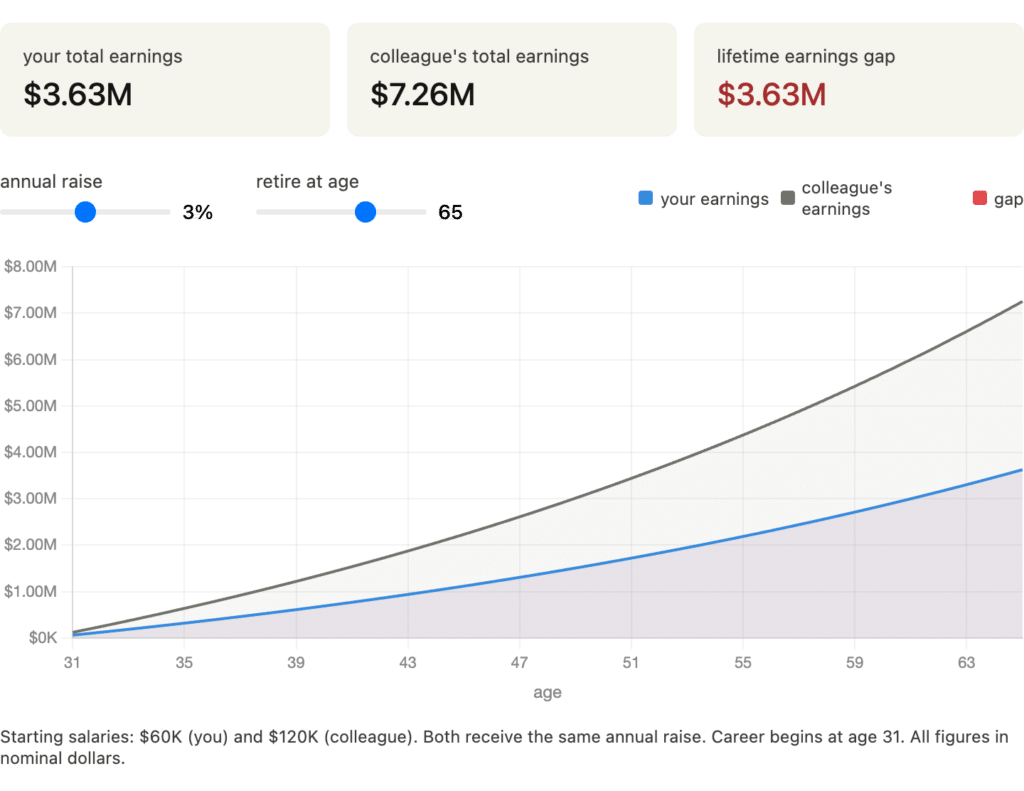
For the sake of the example, these figures assume identical career paths (same raises, same trajectory, same time in the workforce). As we all know, real careers are messier. Some women outpace their colleagues through promotions, smart negotiation, or strategic job changes (thankfully, that worked out for me). But for most women, closing the gap is harder than it sounds, and the math rarely moves in our favor.
Maybe you’re not facing a 2X salary gap. Maybe you’re not concerned because the gap is only $5K or $10K. Enough to sting, but not enough to feel like a crisis.
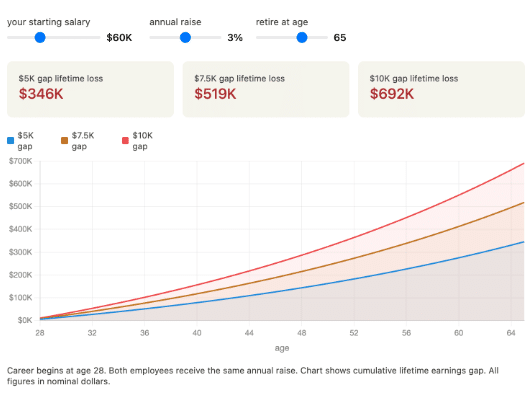
I have some bad news for you. It’s a crisis. If your starting base salary of $60,000 has a $5,000 pay gap, it multiplies into a lifetime earnings loss of over $340,000. A $10,000 gap? More than $680,000. Gone. Poof!
Today is Equal Pay Day. It shows how far into the new year women must work just to earn what men did the previous year: 81 cents on the dollar for full-time workers, 76 cents when including part-time and seasonal workers. Worse? The trend is heading in the wrong direction: the gender pay gap widened for the second year in a row (the first time this happened since the data tracking began over 60 years ago!).
The gap tends to be baked in early, when women have the least leverage, the least data, and the least confidence to negotiate. It’s difficult to know what colleagues make. It can be hard to ask for more, especially when you really need a job. You might also tell yourself the difference is small enough not to matter (hopefully the diagrams above convince you otherwise).
It matters.
It matters because every subsequent raise is a percentage of the unfair number.
It matters because your next salary negotiation can often be anchored to your current one.
And, it matters because retirement contributions, Social Security payouts, and investing capacity all build on what you earn now.
You might be surprised (or pissed off) to learn women retire with about 39% less in savings than men. Most retirement contributions are a percentage of your paycheck. If the paycheck is smaller, the contribution is smaller, the employer match is smaller, and the compounding growth on all of it is smaller. (Smaller – see the trend here?) Further, A T. Rowe Price study found that the median 401(k) balance for women was 65% lower than for men.
65%!
Women also tend to live about 4-5 years longer, on average, which means less money needs to stretch further. As for Social Security? The average retired man collects about $2,284 per month. The average retired woman? $1,875. That’s roughly $400 less hitting her bank account every single month for the rest of her life. And Social Security is calculated on your highest 35 years of earnings, so every underpaid year and every career break (including motherhood!) gets locked into that formula permanently. Not good.
So the pay gap that feels like a small negotiation problem at 31 becomes a big wealth gap by 65.
Pay and wealth inequities inspired numerous chapters in my forthcoming book, UP!: The Playbook for Every Woman on the Rise.” Written with my sister, Katy, we dedicate numerous chapters to help women learn how to:
– Know Your Value
– Get Good with Money
– Promote Yourself
– Make the Ask
– Know When to Go
If this is of interest to you, consider pre-ordering now to get access to exclusive bonus content. UP! releases on June 2, 2026.
Until then, I will continue to drip, drip, drip the content to help you build a career and life you love.
You are equipt to scrutinize that pay gap.