Work-life balance. I’m all for it.
I know some peers who might give me an eyeroll right now.
They may have grown up “grinding it out” and “paying their dues,” and think the pursuit of balance is for those who don’t want to work hard, lack commitment, or aren’t serious about achieving success. They quietly–and not so quietly–fume when younger generations talk about work-life balance.
I grinded it out. I paid my dues. Yet I admire the younger generations pushing back against being “all in” or “always on,” and against foregoing a personal life while building a career. According to Deloitte, only 6% of Gen Z professionals say their primary goal is to climb the corporate ladder. Good for them. Instead, their top three goals are opportunities to progress in their careers, work-life balance, and learning and development.
These goals – progressing, developing new skills, and balance can co-exist. (And I suspect most Gen Zer’s cringe when they hear the phrase “climb the corporate ladder” even though they want to learn and progress.)
Yet balance is a squishy term. In other words, it means different things to different people.
Depending on who you ask, work-life balance could mean being able to tend to personal things during the workday without permission, working when it’s convenient based on lifestyle needs, or integrating work and life in a way that feels cohesive, manageable, and flexible.
But with smartphones and other digital technologies pinging at any hour of any day, how can you turn off without being perceived as entitled or uncommitted?
This is where boundaries come in.
Think of boundaries as your tool for achieving balance. Boundaries are a way to define and communicate what is acceptable and reasonable to you. They help you stay focused on your priorities, manage your time, maintain healthy relationships, and avoid burnout. You could say that boundaries are an often-overlooked form of self-care and a vital tool for creating a work-life balance that works for you. To some degree, boundaries make sustainable success possible.
So how can you establish boundaries and effectively communicate them to others?
- Assess your situation. This is when knowing what you need gets real. Think about your experience at work and home. What makes you feel good, inside and out? Notice the people or situations that energize or drain you, or what causes you to feel resentful or overwhelmed. Those reactions are often signals that your values are being violated and you need to set a boundary. Distinguish between something that happens occasionally (everyone has to work late from time to time) versus a consistent pattern (working late every night for weeks or months).
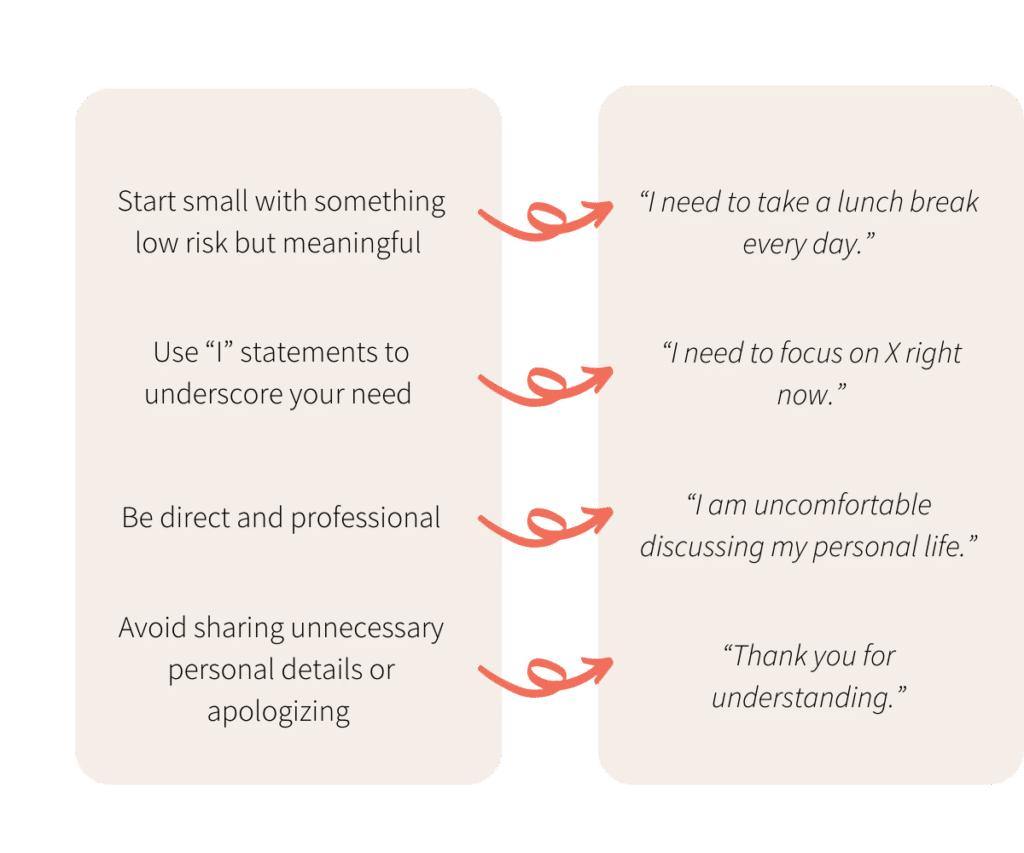
- Set a boundary. As a general rule, boundaries are firm, clear, reasonable, and consistent. And by the way, avoid using the word “boundary” when communicating about one, as it could be perceived as demanding or contentious. A boundary is a good thing, so use positive words to talk about it, such as “I work best when…” or “What helps me succeed is…”
When you’re not in charge, it may feel challenging to create and enforce boundaries, but it’s possible (and doable!). Here’s how:
- Name your non-negotiables. Everyone’s non-negotiables are different. Consider if someone’s request is immoral, unethical, illegal, or harmful to someone else (or you). You may have a prior commitment that can’t be rescheduled or simply don’t have the capacity. Maybe the request is not aligned with your responsibilities and priorities or can be solved in other ways. Last, maybe you are exhausted and need to protect your health and energy. Totally reasonable.
The hard part of upholding boundaries is getting comfortable saying “no.” Saying “no” requires tact, a brief rationale, and a potential alternative solution. If, for example, a colleague from another department is asking you to stay late, you might say something like this:
“Thank you for thinking of me. Unfortunately, I’m focused on several priorities set by my manager that have demanding deadlines right now. I recommend you check with [person capable of doing the job] who has the skills and might have the capacity.”
- Know when to bend. While boundaries are firm, don’t be an unscalable wall. Occasionally, you will find it beneficial to be flexible and say “yes” to a request when it benefits you or a relationship you value. “Yes” might be the answer at work when someone is in a pinch, and only you can help, it’s an opportunity to stretch or learn something new, it’s an opportunity to work on a high-profile project or with a senior leader, or you want to do more to earn more sooner.
- Think it over. Don’t feel rushed into a decision. If you’re not sure if “no” or “yes” is the right decision for you, give yourself 24 hours to think about it. And if a full day isn’t possible, you might say, “I am unable to give this my full attention right now. Let me get back to you in an hour.” This gives you a little time to assess your priorities and respond thoughtfully and unemotionally.
At the end of the day, healthy boundaries are like a good fence—they keep the right things in and the wrong things out, but they still serve as a gate. Don’t be afraid to open that gate when something worthwhile comes along, whether it’s a stretch assignment, a networking opportunity, or a chance to mentor someone you care about. Boundaries that are too rigid can box you in and limit your opportunities. The objective is to protect your well-being while staying open to the possibilities that help you grow.
You are equipt to establish healthy boundaries.